Do you ever feel tingling or numbness in your hands and feet? This sensation, known as paresthesia, is one of the many symptoms of vitamin B12 deficiency. You might also experience fatigue, weakness, pale skin, and mood changes—all of which can be linked to low B12 levels.
Symptoms of B12 deficiency
✅ Fatigue & Weakness – Due to poor oxygen transport caused by malfunctioning red blood cells.
✅ Pale skin or Jaundice –ineffective RBC production and increased breakdown.
✅ Shortness of Breath & Dizziness – Due to oxygen deprivation.
✅ Heart Palpitations – As the heart compensates for low oxygen levels.
✅ Mouth Ulcers – The tongue may become swollen, red, and sore.
✅ Neurological Symptoms – Unlike folate deficiency anemia, B12 deficiency can cause numbness, tingling, cognitive issues, and mood disturbances due to nerve damage.
Physiology
Vitamin B12, also known as cobalamin, is an essential nutrient that plays a critical role in the body. It serves as a coenzyme in the synthesis of myelin, the protective sheath around nerves. This function is crucial because myelin integrity directly affects neurotransmitter production and overall nerve function. Given its importance, it’s no surprise that vitamin B12 deficiency is associated with various neuropsychiatric disorders (1).
Serum cobalamin levels are generally a sensitive marker of B12 deficiency. In fact, 95% of patients with low B12 levels show elevated serum methylmalonic acid (MMA) or total homocysteine levels (2). But why does this happen?
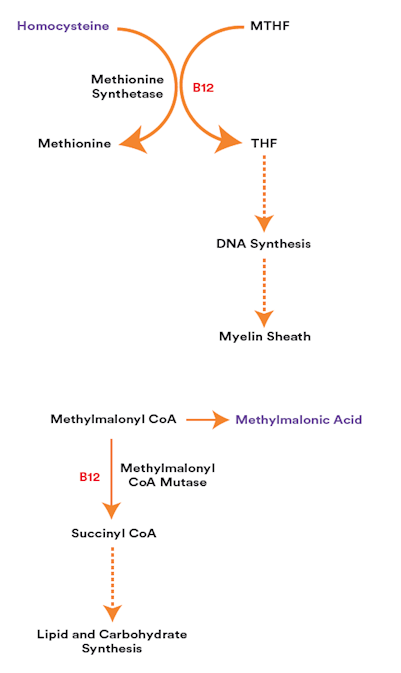
Vitamin B12 acts as a cofactor for two key enzymes:
- Methionine synthase, which plays a role in DNA synthesis and neurotransmitter regulation
- Methylmalonyl-CoA mutase, which is essential for fatty acid metabolism and myelin production (3)
When B12 is deficient, these enzymes cannot function properly, leading to a buildup of methylmalonic acid and homocysteine, both of which can contribute to neurological damage and cardiovascular risks. The most accurate way to check B12 deficiency is checking these two byproducts instead of vitamin B12, because cobalamin is not sensitive to certain measurement.
1) Cureus. 2022 Jan 21;14(1):e21476. doi: 10.7759/cureus.21476
Neuropsychiatric Disorders Associated With Vitamin B12 Deficiency: An Autobiographical Case Report
Ahmed Badar 1,✉
2) American Journals of Hematology. Diagnosis of cobalamin deficiency: II. Relative sensitivities of serum cobalamin, methylmalonic acid, and total homocysteine concentrations
Dr. John Lindenbaum, David G. Savage, Sally P. Stabler, Robert H. Allen
3) Vitamin B12: Testing for the diagnosis of deficiency in general practice. Austrailian Clinical Labs.
High Homocysteine and MMA
Homocysteine is an amino acid and a natural byproduct of protein metabolism. It is temporarily produced as an intermediate metabolite when the body breaks down methionine, an essential amino acid. Under normal conditions, homocysteine is quickly converted into other compounds and does not accumulate in the body. Ideally, its levels should remain below 15 µmol/L.
- However, when vitamin B12 levels are low, homocysteine metabolism is disrupted, causing its levels to rise above the normal range. This condition, high homocysteine, can have serious health consequences. One of the most concerning effects of elevated homocysteine is its impact on the heart and blood vessels. High homocysteine levels can damage blood vessels and trigger inflammation, increasing the risk of atherosclerosis , blood clots, heart disease, and stroke. Impaired blood vessels may lead to high blood pressure.
- One of the most severe consequences of vitamin B12 deficiency is neurological damage. High levels of homocysteine and methylmalonic acid (MMA) contribute to oxidative stress, which can lead to memory loss, cognitive decline, depression, anxiety, Alzheimer’s disease, and dementia. Vitamin B12 plays a crucial role in nerve protection. When B12 levels are low, the myelin sheath that surrounds and insulates nerve cells begins to deteriorate, a process known as demyelination. As this occurs, nerve fibers become damaged, leading to symptoms such as numbness, tingling (paresthesia), and muscle weakness. Elevated MMA levels are a direct indicator of B12 deficiency. If left untreated, peripheral neuropathy can develop, and nerve damage may become irreversible over time. Cognitive functions continue to decline, resulting in memory loss, brain fog, and mood disorders such as depression and anxiety.
- Megaloblastic anemia is a serious condition often caused by vitamin B12 deficiency, leading to impaired red blood cell (RBC) production. Cobalamin (B12) is essential for DNA replication in bone marrow cells. Without it, cell division is disrupted, resulting in the formation of large, immature RBCs, known as megaloblasts. These abnormal RBCs are dysfunctional and unable to carry oxygen efficiently, causing symptoms similar to anemia. As a result, the body experiences reduced oxygen delivery, leading to fatigue and weakness. Ineffective RBC production and breakdown can also cause pale skin or jaundice.
Vitamin B12 Deficiency: The Real Concern
The lack of vitamin B12 itself isn’t the main issue. Instead, the real problem lies in the harmful byproducts that accumulate when B12 is deficient. Today, we explored two key substances—homocysteine and methylmalonic acid (MMA)—to better understand the symptoms that can arise from chronic B12 deficiency.
Fortunately, most of these symptoms can be easily managed by improving dietary habits. Vitamin B12 (cobalamin) deficiency is closely linked to diet. Since B12 is mainly found in animal-based foods such as meat, fish, eggs, and dairy, people who do not consume these foods regularly are at a higher risk of deficiency. Organ meats, particularly liver, are rich in B12, but vegetarians and vegans are more likely to develop a deficiency because plant-based foods naturally lack this vitamin. Additionally, a diet high in processed foods can also contribute to the problem, as these foods are often stripped of essential nutrients, including B12. If getting enough B12 from food alone is challenging, taking supplements or consuming fortified foods is a great way to ensure adequate intake!

 쪼약 조수진
댓글 남기기