
Retinoid medication we often take orally to promote skin health. There are 3 types of retinoids we can find to treat disease. Let’s learn about some retinoids and their uses. And I’m going to give you some really useful cautions that everyone should know while taking retinoids.
- Isotretinoin: Isotretinoin inhibits sebum secretion to treat acne. Indicated for severe nodular acne in nonpregnant patients who are unresponsive to conventional therapy.
- Alitretinoin: As a form of vitamin A, alitretinoin was started to use as an anti-cancer agent. This is a first-generation retinoid, and it is now used for treating severe hand eczema. Especially in adults with a recurrent chronic disease that does not respond to topical steroid therapy.
- Acitretin: Vitamin A derivative used to treat severe keratosis, such as topical or systemic forms of psoriasis. Taken after a meal because it is fat-soluble.
How does it affect the fetus?
Retinoids, a class of compounds derived from vitamin A, have serious side effects. It has a teratogenic effect, which means that it can harm the fetus during pregnancy. Vitamin A is an important micronutrient for pregnant women and fetuses, essential for the development of many organs like the eyes. So, vitamin A deficiency is harmful during pregnancy. But what we are going to discuss is excessive vitamin A intake. Like vitamin A deficiency, it is very dangerous during pregnancy because of its teratogenic effects. So, prenatal vitamin A supplement is literally not recommended.
Isotretinoin and Alitretinoin
Isotretinoin is a drug group of derivatives of vitamin A, which is used to treat dermatological conditions but is teratogenic (1). Fetal risk is possible if pregnant during or within one month after treatment of this drug, like miscarriage and malformations in the central nervous system and cardiac and coronary vascula. Brain malformations, skull abnormalities, and eye or ear deformities are also. So, isotretinoin is contraindicated during pregnancy.
Alitretinoin for the treatment of chronic hand eczema does have similar side effects. The teratogenic effects include craniofacial, cardiovascular, thymic, central nervous systemic, and retinoid embryopathy (2).
Acitretin and etretinate
Acitretin and etretinate, active metabolite of vitamin A, are medications used to treat severe psoriasis. There may be a fetal risk if pregnant during or within 3 years of the end of this medication. Spontaneous abortion or congenital malformation is high when the drug is administered during the first trimester of pregnancy (3). There is also the risk of malformation of the face, eyes, ears, hips, ankles, forearms, and fingers. Deformities in cranial volume, cervical, brain, and cardiovascular.
Precautions for childbearing women
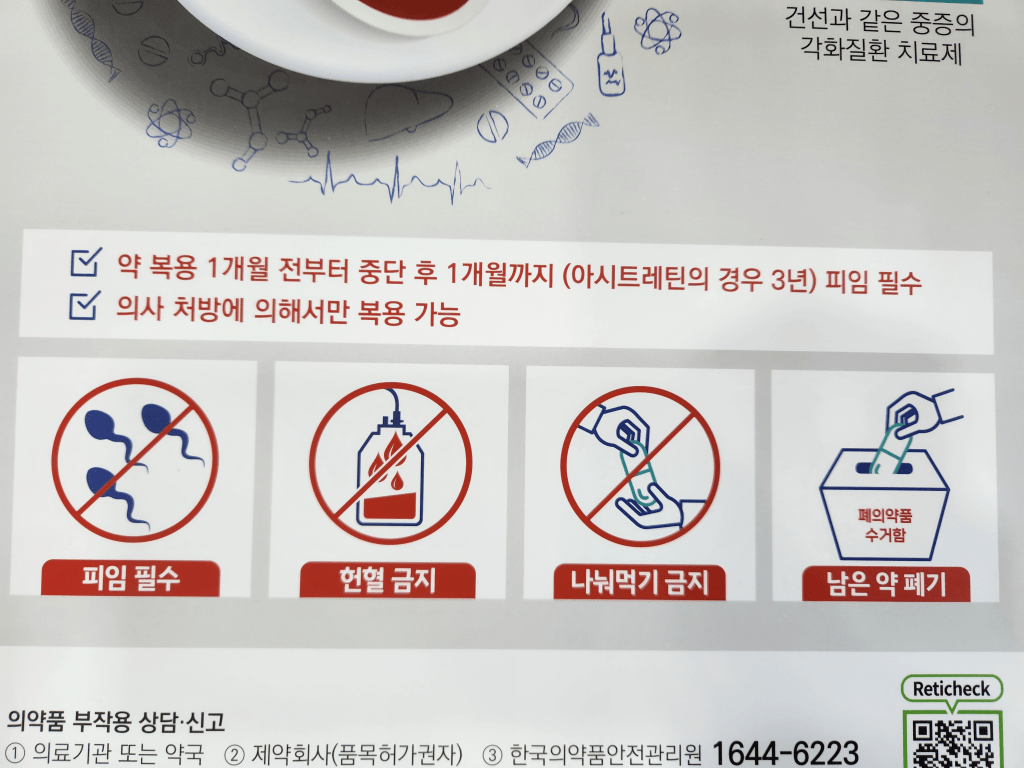
Do not take this drug if you are currently pregnant or are likely to become pregnant. Contraception with two or more contraceptives from one month before taking the drug to one month after stopping. If you took actretin, a three-year term is safe.
Pregnancy should be checked from 1 month before taking the drug to 1 month after stopping (three years for acetretin). If there is a possibility of pregnancy, consult a prescription doctor.
Consult with a doctor or pharmacist when taking this drug and hormonal contraceptive because the effectiveness of the hormone contraceptive may decrease. And possible interaction with hormonal contraceptives: Avoid self-medicating with St John’s Wart. (Pregnancy has been reported when used in combination).
Precautions for non-female and Male
Those who are unlikely to become pregnant are also encouraged to use effective contraception while taking this drug. Use a condom for 30 days after barely administering a male patient who overdosed on this drug and sexual love with a pregnant woman during pregnancy.
- Primary contraception: ovarian ligation, vasectomy, loop IUD, contraceptives
- Secondary contraception: condom, vaginal sponge, cervical cap
With vitamin A included, consult with doctors and pharmacists on medicines and dry foods.
Blood donation is prohibited up to one month after medication/interruption (three years of ascitretin).
References
1) Sabina Bastos Maia,1,2,* Alex Sandro Rolland Souza,1,3,4 Maria de Fátima Costa Caminha,1,5 Suzana Lins da Silva,1,5 Rachel de Sá Barreto Luna Callou Cruz,6 Camila Carvalho dos Santos,7 and Malaquias Batista Filho1. Vitamin A and Pregnancy: A Narrative Review. Nutrients. 2019 Mar; 11(3): 681.
2) Vivian Y Shi1 , Raja K Sivamani1 & Howard Maibach. Alitretinoin for the treatment of chronic hand eczema: clinical rationale. Clin. Invest. (Lond.) (2014) 4(8)
3) J M Geiger 1, M Baudin, J H Saurat. Teratogenic risk with etretinate and acitretin treatment. Dermatology. 1994;189(2):109-16.

 쪼약 조수진
댓글 남기기